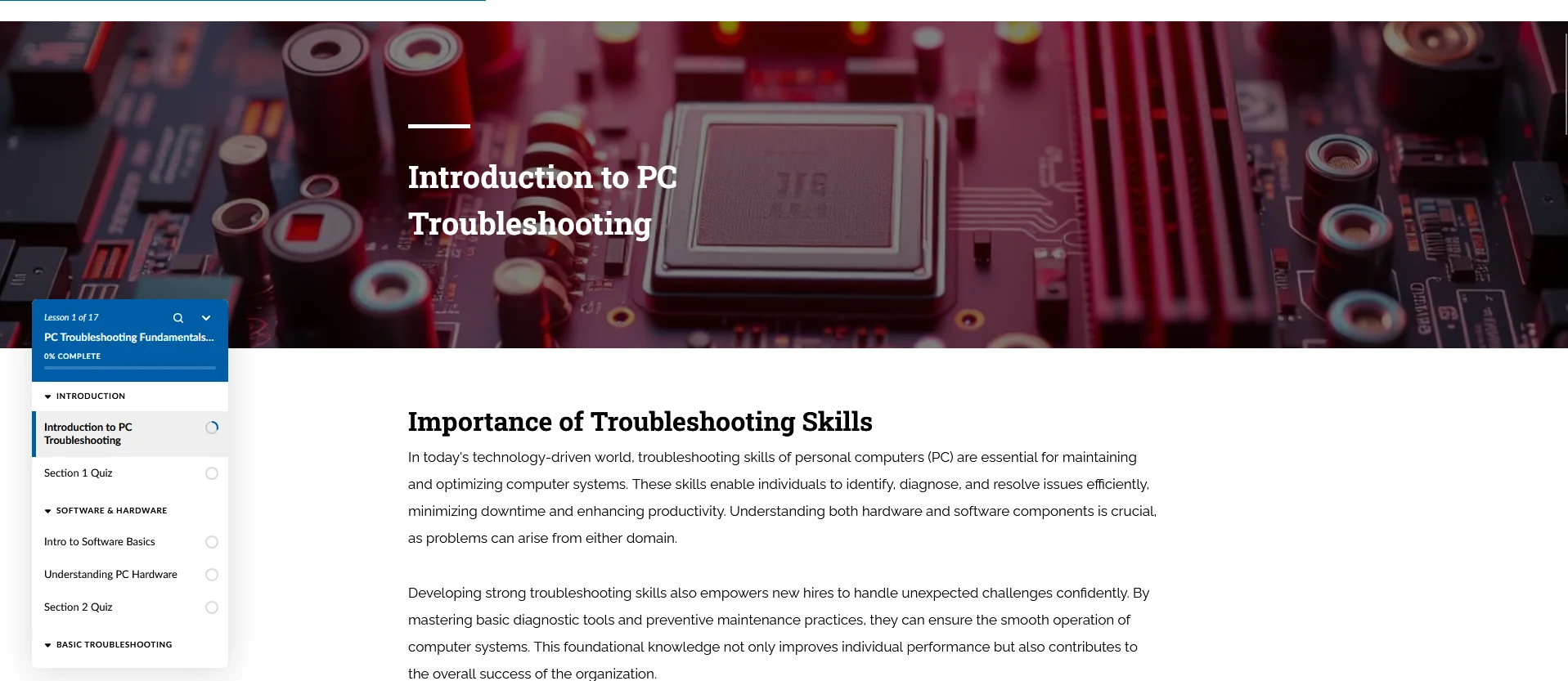
The Context
When you're supporting customers with technical issues, you need to understand what
you're working with. But new hires come from everywhere—some with IT backgrounds,
others who've never opened Task Manager. We couldn't assume any baseline.
This course slots into Week 1 of Customer Care Technician onboarding, alongside
compliance training. It's treated as a prerequisite: pass before you continue to
role-specific training. For experienced hires, test-out options prevent it from
being a waste of time. For everyone else, it's exposure to the technical foundation
they'll build on.
🧪 The Experiment
This course was also an intentional test of Articulate's AI Assistant, which had
just released for Rise 360. A new class was starting in a few weeks, we needed
the course, and the timing aligned. I wanted to see how AI-assisted content
generation could accelerate development without sacrificing quality.
My Role
I designed and built this course independently—instructional design, content development,
quiz writing, video scripting, and the full Rise 360 build. The AI Assistant handled
rapid content generation from my source documents; I handled the editorial pass, error
correction, and human polish that makes training feel less robotic.
Course Structure
Four sections progressing from foundational concepts to practical troubleshooting.
Each section ends with a quiz checkpoint—learners must demonstrate understanding
before moving forward.
01
Introduction
Why troubleshooting skills matter. Setting expectations for what learners will be able to do.
02
Software & Hardware
Internal components, peripheral devices, software basics. What's inside the box and why it matters.
03
Basic Troubleshooting
Common software problems, hardware diagnostics. Resolving the issues learners will see most often.
04
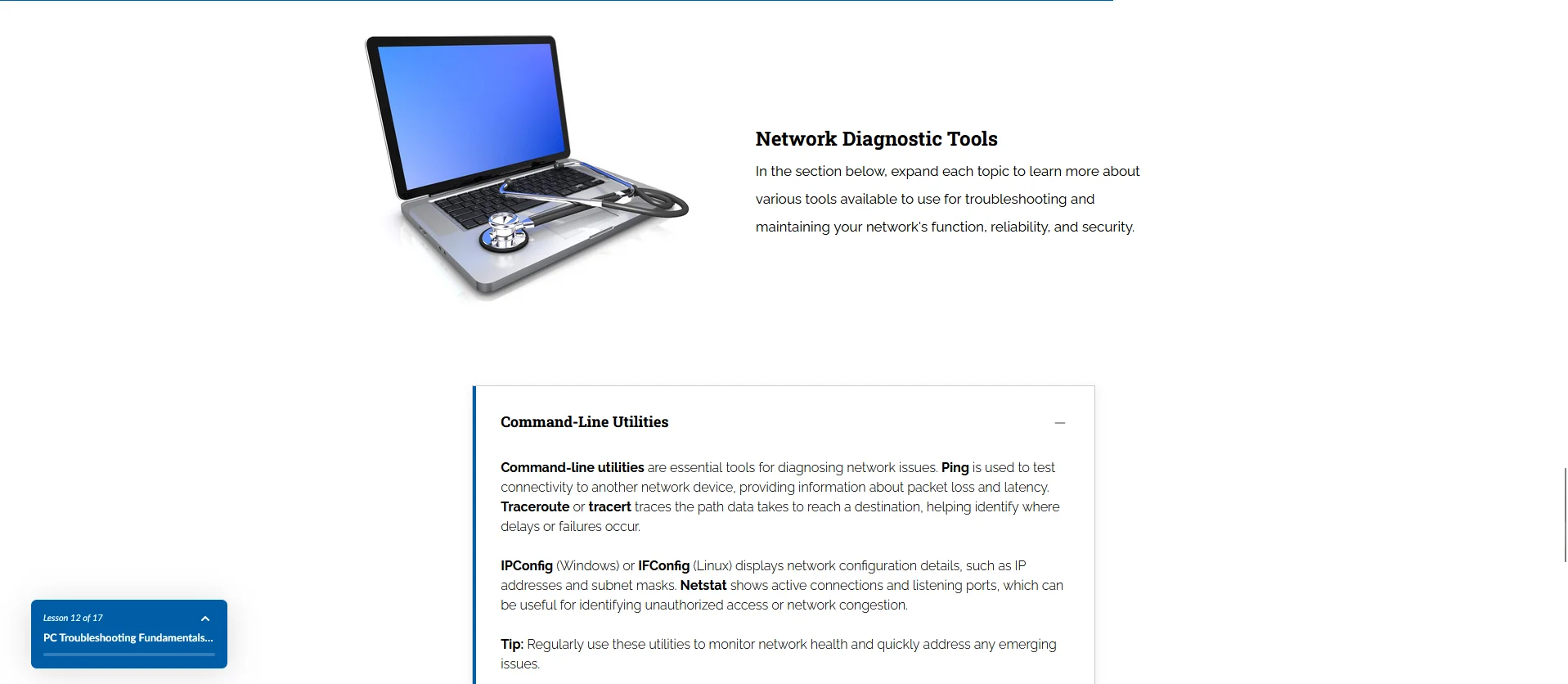
Network & Connectivity
Router setup, IP conflicts, Wi-Fi optimization, command-line diagnostic tools.
AI-Assisted Development
Articulate's AI Assistant had just launched, and I had a tight timeline. This became
a deliberate experiment: could AI accelerate content development without compromising
instructional quality?
Source Documents
I prepared topic outlines and reference materials covering each section's learning objectives.
AI Generation
Prompted the AI Assistant to translate documents into lesson content, working section by section.
Human Polish
Manual review of every generation—catching errors, adding context, adjusting tone for learner experience.
The result: faster development without the "obviously AI-written" feel. The AI handled
the heavy lifting of initial content structure; I handled the editorial judgment that
makes training actually work.
The Little Things
Technical training doesn't have to be dry. Throughout the course, I looked for
opportunities to add unexpected moments that make the content more human.
Sometimes that's a visual metaphor. Sometimes it's this:
Wires tangled and frayed.
Silent fans hum a soft tune.
Life restored anew.
— A Hardware Haiku, tucked into the diagnostics section
I'd honestly forgotten I put that in there until reviewing the course for this
case study. That's the kind of detail that makes learners smile—and maybe
remember the content a little better.
Tools & Approach
Primary Build Tool
Articulate Rise 360
Content Acceleration
Articulate AI Assistant
Video Content
Synthesia AI
Deployment
SCORM 1.2 / LMS
No flashy integrations or custom code—just well-structured content and
learner-friendly pacing. Rise 360's responsive design means it works on
whatever device learners happen to be using.
Design Insights
AI accelerates, humans refine. The Articulate AI Assistant cut
initial content development time significantly. But every generation needed human
review—error correction, tone adjustment, adding the context that makes content
actually useful. AI is a tool, not a replacement for instructional judgment.
Test-out options respect experienced learners. Making everyone
sit through foundational content they already know is a waste of everyone's time.
Test-out options let experienced hires prove competency and move on.
Prerequisites create accountability. Positioning this as a
must-pass before continuing to role-specific training means learners take it
seriously. It's not optional enrichment—it's the baseline everyone needs.