The Design Challenge
"Conflict rarely appears out of nowhere. Most disputes start small, but if ignored, they
can spiral." That's how the course opens—and it's also the design problem I was solving for.
Leadership training often falls into two traps: either it's a 15-minute "dusting of learning"
that checks a box but builds no real skill, or it's a multi-hour commitment that managers
simply won't complete. I needed something in between—substantial enough to actually change
behavior, compact enough to fit into a busy leader's day.
⏱️ The Constraint
Get all five modules—spotting conflict, de-escalation, mediation, boundaries, and
follow-up—into under an hour total. Each module also needed to stand alone so leaders
could complete them in chunks rather than one sitting.
My Role
I led this project end-to-end: instructional design, interactive writing, scenario scripting,
video coordination with Synthesia AI, and final implementation in Storyline 360. This was an
internal build for ITI (now Neumo), designed to support mid-level managers, team leads, and
emerging leaders across the organization.
Course Structure
Five modules that progress from recognition to resolution to reinforcement. Each module
was designed to stand alone—uploaded separately to the LMS so leaders could complete them
in chunks across multiple sessions if needed.
01
~8 min
Spotting & Assessing Conflict
Recognizing early warning signs before situations escalate. Verbal cues, behavioral changes, and when to intervene.
02
~10 min
De-Escalation Tactics
Calming heated situations using neutral language, body positioning, and what NOT to say when emotions are high.
03
~12 min
Mediation & Resolution
Structured techniques for facilitating difficult conversations. Maintaining neutrality while moving from blame to solutions.
04
~5 min
Boundaries & Accountability
Setting expectations with empathy, knowing when to document, and holding employees accountable for agreements.
05
~5 min
Following Up After
Preventing recurring conflicts through check-ins that support rather than police. Knowing when "resolved" actually means resolved.
Design Approach
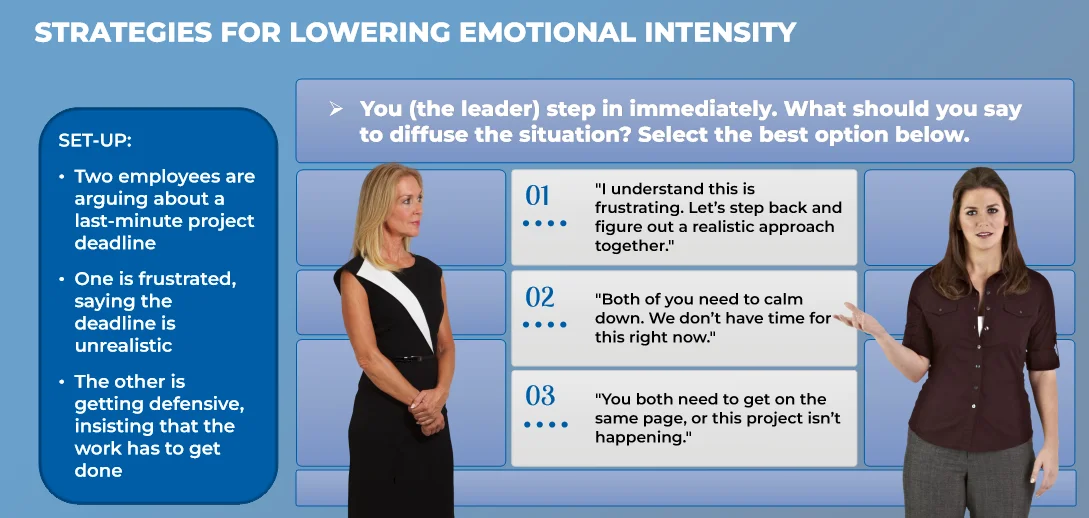
The course opens with a decision, not a definition. Learners walk into a break room where
two employees are arguing—notebook slammed down, arms crossed, voices raised. "What do you do?"
They choose. They see the consequences. Then we teach them why.
This scenario-first approach runs throughout the course. Every module puts learners in a
situation before explaining the theory behind it. The goal: build judgment, not just knowledge.
Branching Scenarios
Multi-step decision paths where choices compound. De-escalate well in step one, and step
two gets easier. Miss the cues early, and the situation spirals—just like real conflict.
Spot-the-Mistake Activities
Learners identify what's wrong with common leader responses. "You're overreacting" and
"We don't have time for this drama" look obviously bad—until you're in the moment.
Drag-and-Drop Categorization
Sorting behaviors into "Minor Tension," "Escalating Conflict," and "Full Dispute"
helps leaders calibrate their intervention timing.
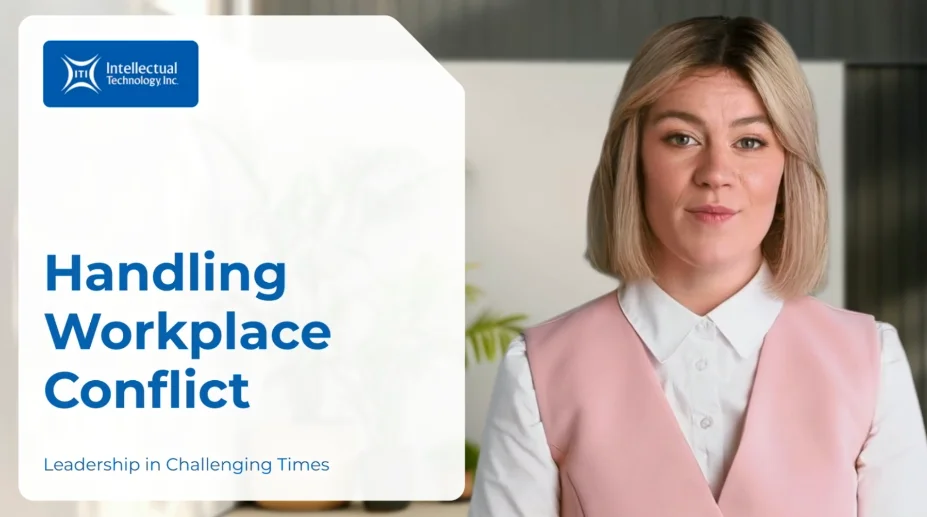
AI Video Assessments
Synthesia-generated video scenarios with decision points. The AI presenter sets up
situations; learners choose responses; immediate feedback explains the impact.
Hybrid Tooling Approach
The scenario interactions combine Storyline 360's power with Rise 360's efficiency. Rise 360
has a pre-built scenario block that handles branching logic cleanly—I built the scenarios there,
then imported them as web objects into Storyline. Best of both worlds: Rise's organized UI for
rapid scenario development, Storyline's flexibility for everything else.
This wasn't just experimentation—it was a time constraint decision that paid off. Building
each branching scenario by hand in Storyline takes significantly longer. The hybrid approach
let me focus design energy on the interactions that actually needed custom treatment.
Core Authoring
Storyline 360
Scenario Blocks
Rise 360 (as web objects)
Video Generation
Synthesia AI
Video Editing
Adobe Premiere Pro
Custom Interactions
JavaScript
Deployment
SCORM 1.2 / LMS
How This Differs from Difficult Conversations Training
I've built courses in both spaces. Here's how they're distinct:
Managing Workplace Conflict
This course — Reactive
Handling tension that's already surfaced. Outbursts, friction between team members,
de-escalation in the moment. How do you intervene when conflict is actively happening
and restore productive working relationships?
Difficult Conversations
Separate course — Proactive
Initiating uncomfortable dialogue before it becomes conflict. Performance issues,
disengaged employees, sensitive feedback. How do you start conversations that most
leaders avoid having?
Design Insights
Scenario-first beats theory-first. When learners make a decision before
understanding the framework, they're invested in learning why their choice worked—or didn't.
The emotional engagement is higher because they've already experienced the stakes.
Modularity enables completion. Uploading each module separately wasn't just
a nice-to-have—it acknowledged that leaders won't always have 40 uninterrupted minutes.
Breaking it into 5-12 minute chunks meant higher completion rates without sacrificing depth.
Hybrid tools save time without sacrificing quality. Using Rise 360 for
scenario blocks and importing them as web objects into Storyline let me build faster while
keeping the custom interactions that actually needed Storyline's power.