The Challenge
In 2024, Neumo underwent a significant corporate merger—combining two organizations with distinct cultures, processes, and most critically, different policy documentation. Over 200 pages of static PDFs sat scattered across legacy systems, with no unified way for the combined workforce to find what they needed.
Employees were spending 15+ minutes searching for specific policies. The most common HR support tickets? "Where do I find [policy X]?" Different state locations (California, Texas, etc.) had jurisdiction-specific variations buried in footnotes. New hires from the acquired company had no idea which legacy policies still applied to them.
🚫 The Constraint That Changed Everything
During the merger transition, I had zero access to the backend infrastructure. No database modifications. No server-side authentication. No API endpoints I could leverage. Any solution had to work entirely from what I could control: the frontend.
Oh, and the platform I had to build on? Umbraco 7.14—a CMS that hit end-of-life in 2023. I had to learn Umbraco from scratch while building to its constraints.
My Role
As a one-person L&D department, I owned this end-to-end: research, UX design, technical architecture, development, content strategy, and stakeholder management across both merged organizations.
The Solution
💡 The Key Innovation
Traditional authentication requires backend validation. Without backend access, I inverted the model: the login page itself became the authenticator. The frontend handles role verification and routes users to appropriate content—achieving the same business outcome without touching the backend.
Beyond authentication, I built a complete platform transformation:
🔍 Full-Text Search
Instant search across all 200+ policies using Umbraco's content cache. Employees find answers in seconds instead of digging through PDFs.
📍 State-Specific Overlays
California employees see CA employment policies. Texas employees see TX policies. Jurisdiction-specific content surfaced automatically, not buried in footnotes.
📊 Analytics Infrastructure
Click tracking captures which policies employees access and what they search for. Data foundation for identifying gaps and measuring engagement.
✏️ CMS for Non-Technical Editors
HR can update policies through Umbraco's backoffice without touching code. Sustainable solution that doesn't require developer involvement for routine changes.
The Interface
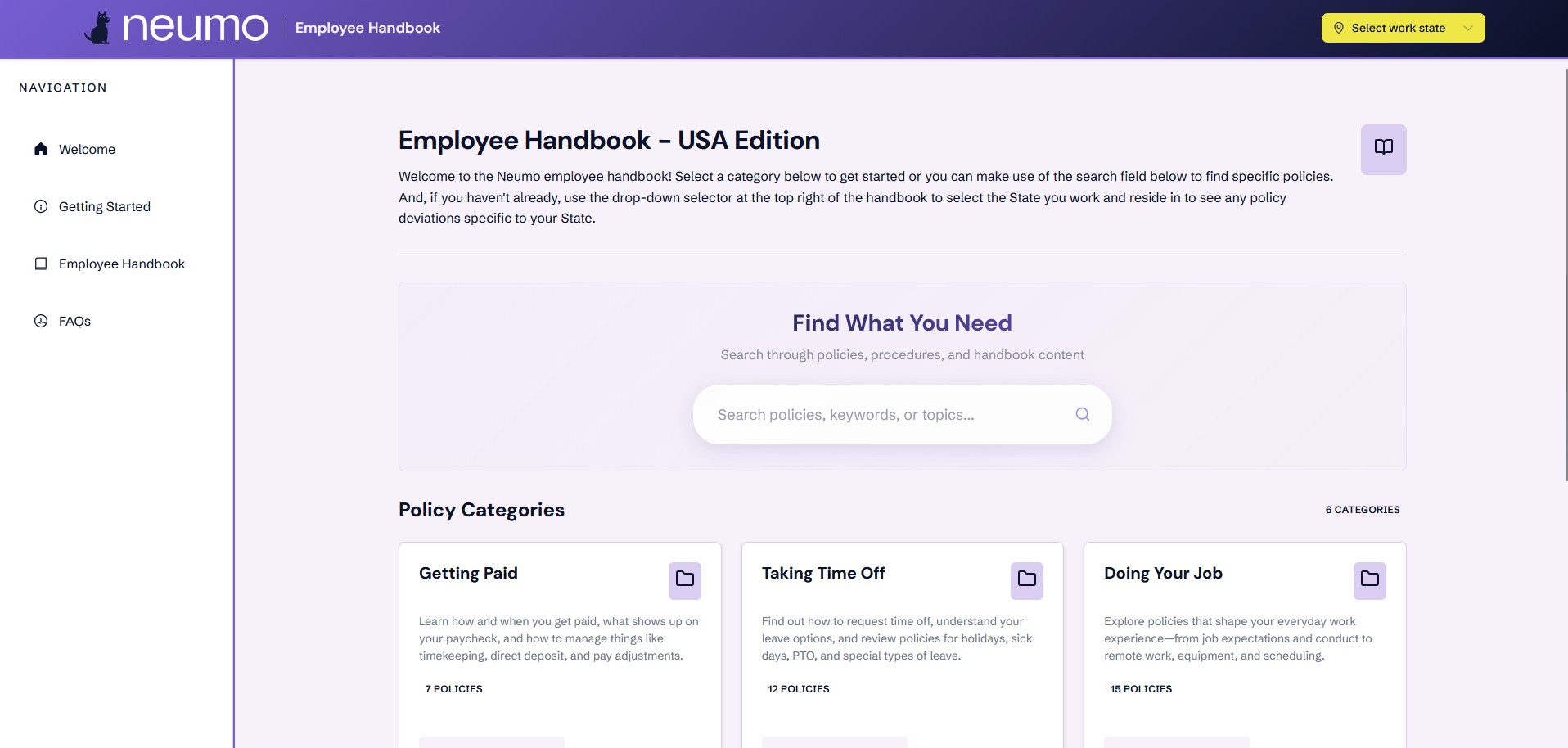
The final product prioritizes findability over organization charts. Search-first design, card-based categories, and a state selector that surfaces jurisdiction-specific content without burying it in footnotes.
Tech Stack
On AI-assisted development: I used AI tools strategically during the authentication engineering phase to accelerate iteration cycles. All architecture decisions, UX design, and system integration remained human-directed. AI shortened development time; it didn't make the hard decisions.
The Results
⚡ Seconds vs. Minutes
Policy lookup time dropped from 15+ minutes of PDF searching to instant search results.
📉 Reduced HR Load
"Where do I find [policy]?" tickets decreased significantly as employees could self-serve.
🔐 Access Control Without Backend
Different employee groups see appropriate policy sets—achieved without any backend modifications.
📱 Mobile-Ready
Responsive design means employees can reference policies from anywhere, not just their desks.
Key Learnings
Constraints force creativity. The no-backend-access constraint initially seemed like a project-killer. It became the most interesting technical challenge. The solution I built wouldn't have emerged if I'd had unlimited access—I would have built something more conventional.
UX problems masquerade as technical problems. The original brief was "digitize our policy PDFs." The actual problem was "employees can't find information they need." A prettier PDF viewer wouldn't have solved the wayfinding problem.
Ship the 80% solution. The search isn't as sophisticated as Elasticsearch. The analytics aren't as rich as a full BI pipeline. But both shipped quickly and provide a foundation for iteration based on real usage data.